Precision Health Co., Ltd.
ไม่อยากทำคีโม ได้ไหม?
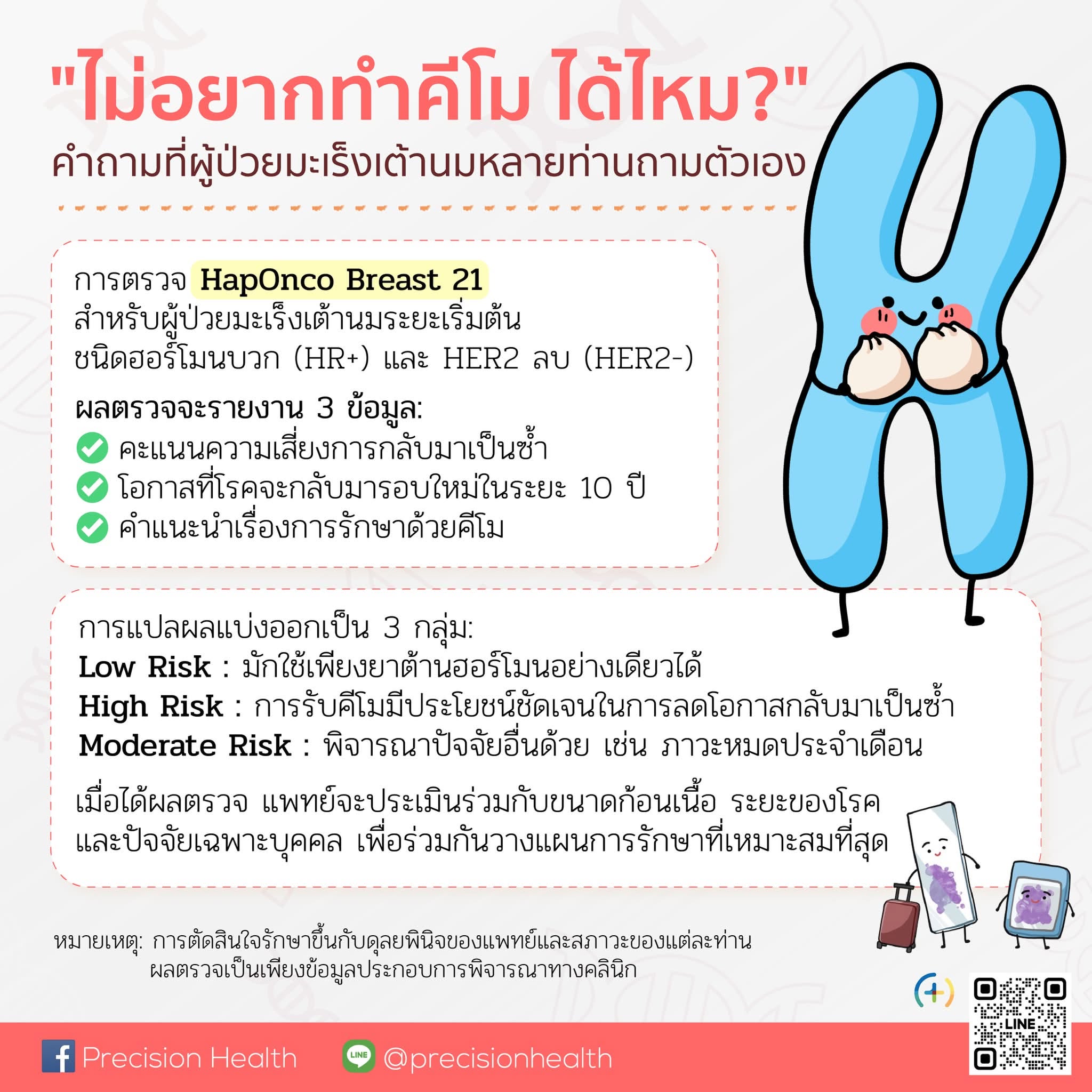
"ไม่อยากทำคีโม ได้ไหม?" คำถามที่ผู้ป่วยมะเร็งเต้านมหลายท่านถามตัวเอง
หลายท่านที่ได้รับการวินิจฉัยว่าเป็นมะเร็งเต้านม มักมีความกังวลเรื่องการรับเคมีบำบัด (คีโม) ทั้งผลข้างเคียง ความเหนื่อยล้า และอาการผมร่วง จนเกิดคำถามในใจว่า "ถ้าไม่รับคีโม... จะได้ไหม?"
ความกังวลนี้เป็นเรื่องปกติมาก แต่ก่อนที่จะตัดสินใจ คำถามสำคัญที่เราควรถามตัวเองและแพทย์ผู้ดูแลคือ "ในเคสของเรา คีโมช่วยได้มากน้อยแค่ไหน?"
เพราะคีโม... อาจไม่ได้จำเป็นสำหรับทุกคน
มะเร็งเต้านมบางชนิด คีโมช่วยลดความเสี่ยงการกลับมาเป็นซ้ำได้มาก
แต่บางชนิด การรับประทานยาต้านฮอร์โมนเพียงอย่างเดียวก็เพียงพอ
แล้วเราจะรู้ได้อย่างไรว่าเราอยู่กลุ่มไหน?
นี่คือบทบาทของ การตรวจ HapOnco Breast 21 สำหรับผู้ป่วยมะเร็งเต้านมระยะเริ่มต้น ชนิดฮอร์โมนบวก (HR+) และ HER2 ลบ (HER2-)
การตรวจนี้ไม่ต้องเจ็บตัวเพิ่ม เพราะใช้ชิ้นเนื้อเดิมที่โรงพยาบาลเก็บไว้จากการผ่าตัดมาตรวจวิเคราะห์
ผลตรวจจะรายงาน 3 ข้อมูลสำคัญเพื่อช่วยวางแผนการรักษา:
1. คะแนนความเสี่ยงการกลับมาเป็นซ้ำ (Recurrence Score)
2. โอกาสที่โรคจะกลับมารอบใหม่ในระยะเวลา 10 ปี (%)
3. คำแนะนำเรื่องการรักษาด้วยคีโม
การแปลผลตรวจแบ่งออกเป็น 3 กลุ่ม:
- Low Risk (คะแนนต่ำ): มักใช้เพียงยาต้านฮอร์โมนอย่างเดียวได้ โดยไม่ต้องรับคีโมโดยไม่จำเป็น
- High Risk (คะแนนสูง): การรับคีโมมีประโยชน์ชัดเจนในการลดโอกาสโรคกลับมาเป็นซ้ำ
- Moderate Risk (คะแนนปานกลาง): แพทย์จะพิจารณาปัจจัยอื่นร่วมด้วย เช่น อายุ และภาวะหมดประจำเดือน
เมื่อได้ผลตรวจ แพทย์จะประเมินร่วมกับขนาดก้อนเนื้อ ระยะของโรค และปัจจัยเฉพาะบุคคล เพื่อร่วมกันวางแผนการรักษาที่เหมาะสมที่สุดสำหรับคุณ ช่วยให้บางท่านไม่ต้องรับคีโมโดยไม่จำเป็น และช่วยให้บางท่านมั่นใจมากขึ้นว่าการรับคีโมนั้นคุ้มค่าและเหมาะสมกับตนเองจริงๆ
หมายเหตุ: การตัดสินใจรักษาขึ้นอยู่กับดุลยพินิจของแพทย์ผู้ดูแลและสภาวะของผู้ป่วยแต่ละท่าน ผลตรวจเป็นเพียงข้อมูลประกอบการพิจารณาทางคลินิก
“Can I Choose Not to Have Chemotherapy?” A Question Many Breast Cancer Patients Ask Themselves
Many patients diagnosed with breast cancer feel anxious about chemotherapy, particularly its potential side effects, fatigue, and hair loss. These concerns often lead them to wonder, “Can I choose not to have chemotherapy?”
These concerns are completely understandable. However, before making a decision, one of the most important questions to ask yourself and your treating physician is: “How much benefit would chemotherapy provide in my specific case?”
Because chemotherapy may not be necessary for everyone.
- For some types of breast cancer, chemotherapy can significantly reduce the risk of recurrence.
- For others, hormone therapy alone may be sufficient.
So, how can you determine which group you belong to?
Introducing the HapOnco Breast 21 Test
The HapOnco Breast 21 test is designed for patients with early-stage, hormone receptor-positive (HR+) and HER2-negative (HER2−) breast cancer.
The test does not require an additional invasive procedure, as it uses the existing tumor tissue collected during surgery and stored at the hospital for analysis.
The test report provides three important pieces of information to help guide treatment planning:
1. Recurrence Score: An assessment of the risk of cancer recurrence.
2. 10-Year Recurrence Risk: The estimated percentage risk of the cancer returning within 10 years.
3. Chemotherapy Guidance: Information to help determine whether chemotherapy may be beneficial.
Understanding the Test Results
- Low Risk (Low Score): Hormone therapy alone may be sufficient for some patients, helping them avoid chemotherapy when it is unlikely to provide meaningful additional benefit.
- High Risk (High Score): Chemotherapy may offer a significant benefit in reducing the risk of recurrence.
- Intermediate Risk (Moderate Score): The physician will consider additional factors, such as the patient's age and menopausal status, when determining the most appropriate treatment.
Once the results are available, the physician will interpret them alongside other important factors, including tumor size, disease stage, and individual patient characteristics, to develop the most appropriate treatment plan.
This approach may help some patients avoid unnecessary chemotherapy while giving others greater confidence that chemotherapy is a worthwhile and appropriate option for their individual circumstances.
Important Note: Treatment decisions should be made by the treating physician based on clinical judgment and each patient's individual condition. Test results are intended to support clinical decision-making and should not be used as the sole basis for determining treatment.