Precision Health Co., Ltd.
ตรวจพาหะโรคพันธุกรรมก่อนมีลูก: ตรวจแค่ “ยีนเดียว” หรือ “จัดเต็ม 700-1000 ยีน” แบบไหนดีกว่ากัน?
ตรวจพาหะโรคพันธุกรรมก่อนมีลูก: ตรวจแค่ “ยีนเดียว” หรือ “จัดเต็ม 700-1000 ยีน” แบบไหนดีกว่ากัน?
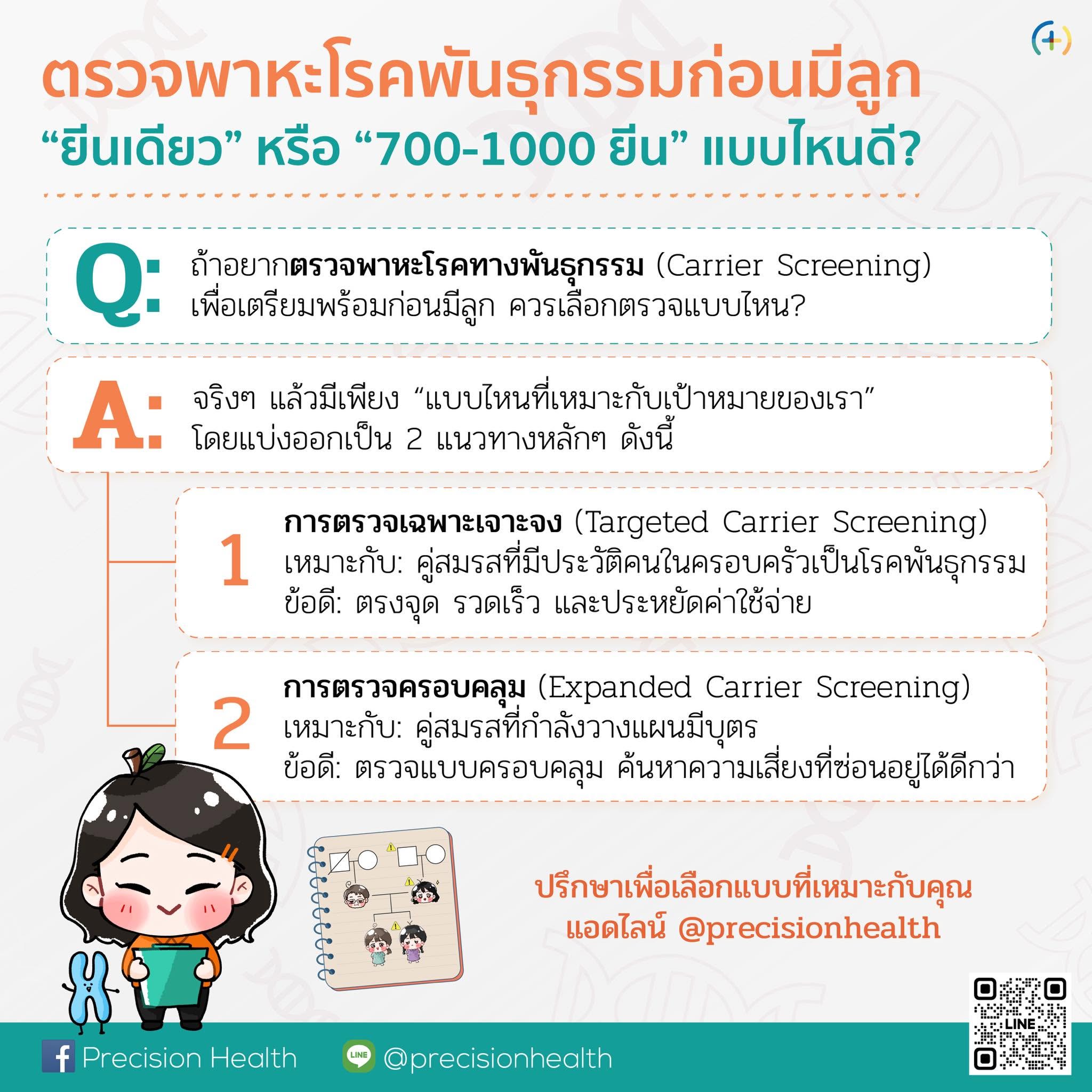
หลายคนคงกำลังสงสัยว่า ถ้าอยากตรวจพาหะโรคทางพันธุกรรม (Carrier Screening) เพื่อเตรียมพร้อมก่อนมีลูก เราควรเลือกตรวจเฉพาะโรคฮิตๆ เป็นยีนเดียว หรือจะเลือกแบบคัดกรองชุดใหญ่ 700 - 1,000 ยีนไปเลยดี?
จริงๆ แล้วไม่มีคำว่าแบบไหนดีที่สุดสำหรับทุกคน มีเพียง “แบบไหนที่เหมาะกับเป้าหมายของเรา” โดยแบ่งออกเป็น 2 แนวทางหลักๆ ดังนี้
1. การตรวจแบบเฉพาะเจาะจง (Targeted Carrier Screening)
เหมาะกับใคร: คู่สมรสที่มีประวัติคนในครอบครัวเป็นโรคพันธุกรรมชัดเจน เช่น มีญาติสายตรงเป็นโรคเลือดจางธาลัสซีเมีย หรือกล้ามเนื้อฝ่อจากไขสันหลัง (SMA)
ข้อดี: เป็นการตรวจที่ตรงจุด รวดเร็ว และประหยัดค่าใช้จ่ายในจุดที่จำเป็น
2. การตรวจแบบครอบคลุมหลายร้อยยีน (Expanded Carrier Screening: ECS)
เหมาะกับใคร: คู่สมรสทั่วไปที่กำลังวางแผนมีบุตร แม้ว่าจะแข็งแรงดีและไม่มีประวัติโรคพันธุกรรมใดๆ ในตระกูลเลยก็ตาม
ข้อดี: ปัจจุบันทางสมาคมพันธุศาสตร์การแพทย์อเมริกัน (ACMG) ได้ให้คำแนะนำว่า มนุษย์เราทุกคนล้วนเป็นพาหะแฝงของโรคพันธุกรรมอย่างน้อย 2-3 โรคโดยไม่รู้ตัว และโรคส่วนใหญ่มักเกิดขึ้นในครอบครัวที่ไม่เคยมีประวัติมาก่อน (มักเป็นยีนด้อยที่ซ่อนอยู่) ดังนั้นการตรวจแบบครอบคลุมหลายร้อยยีน หรือ ECS จึงช่วยอุดรอยรั่วและค้นหาความเสี่ยงที่ซ่อนอยู่ได้ดีกว่ามาก
เทคโนโลยีในปัจจุบันพัฒนาไปไกลมาก ACMG จึงแนะนำให้ตรวจคัดกรองพาหะแบบ ECS ที่ครอบคลุมโรคพันธุกรรมรุนแรงที่พบบ่อยในประชากร โดยไม่จำกัดเฉพาะเชื้อชาติหรือประวัติครอบครัว เพื่อให้คู่สามีภรรยาได้รับข้อมูลที่ครอบคลุมที่สุดก่อนการตั้งครรภ์
สรุปแล้วเลือกแบบไหนดี?
- ถ้าต้องการเจาะลึกตามประวัติครอบครัว = ตรวจเฉพาะยีน
- ถ้าต้องการความอุ่นใจสูงสุด อุดทุกความเสี่ยงที่คาดไม่ถึง = ตรวจแบบครอบคลุม (ECS)
สุดท้ายนี้ ข้อมูลที่ได้จากการตรวจเยอะขึ้น ก็อาจตามมาด้วยความกังวลหรือผลที่แปลผลยาก ดังนั้นการปรึกษาแพทย์ผู้เชี่ยวชาญหรือผู้ให้คำปรึกษาด้านพันธุศาสตร์ (Genetic Counselor) เพื่อเลือกชุดตรวจที่เหมาะสมและอ่านผลร่วมกัน จึงเป็นสิ่งสำคัญที่สุด
Carrier Screening Before Having a Baby: Should You Test Just “One Gene” or Go for a “700–1,000 Gene Panel”?
Many couples wonder whether genetic carrier screening before pregnancy should focus on only a few common conditions or whether it is better to choose a large panel covering 700–1,000 genes.
In reality, there is no single “best” option for everyone. The right choice depends on your goals and personal situation. In general, carrier screening can be divided into two main approaches:
Targeted Carrier Screening
Who is it for?
This option is suitable for couples with a known family history of a specific genetic condition, such as thalassemia or spinal muscular atrophy (SMA).
Advantages:
It is focused, fast, and cost-effective for detecting conditions that are already suspected based on family history.
Expanded Carrier Screening (ECS)
Who is it for?
This option is recommended for couples planning to have children, even if both partners are healthy and have no known family history of genetic disorders.
Advantages:
According to recommendations from the American College of Medical Genetics and Genomics (ACMG), every individual is estimated to be a carrier of at least 2–3 recessive genetic conditions without knowing it. In many cases, affected children are born into families with no previous history of the disease because these recessive genes can remain hidden for generations.
Expanded Carrier Screening helps identify these hidden risks more comprehensively by screening hundreds of genes associated with serious inherited conditions.
With today’s advanced genetic technology, ACMG recommends ECS panels that cover severe and relatively common inherited disorders across populations, regardless of ethnicity or family history. This allows couples to receive the most comprehensive information possible before pregnancy.
So, Which Option Is Better?
- If you want focused testing based on a known family history → Targeted Carrier Screening may be sufficient.
- If you want the broadest possible reassurance and to uncover unexpected hidden risks → Expanded Carrier Screening (ECS) may be the better choice.
Finally, it is important to remember that broader testing can also bring more complex or uncertain results. Therefore, consulting a physician or genetic counselor is essential to help select the most appropriate test and interpret the results accurately together.